
Vaccine Carrier vs Cold Box vs Ice Pack: How Should Cold Chain Equipment Be Chosen for Vaccine Transport in India?
This analysis compares vaccine carriers, short- and long-range cold boxes, and ice packs for vaccine transport in India, explaining capacity, cold life, portability, coolant-pack compatibility and key selection factors.

What to remember
- Vaccine carriers are best suited to smaller, portable vaccine transport requirements.
- Cold boxes provide greater vaccine capacity and generally longer cold-life performance.
- Storage capacity and cold life are separate specifications and should be compared independently.
- Ice packs and water packs must match the container design, vaccine type and applicable transport protocol.
- Hospitals and procurement teams should verify technical specifications, vaccine requirements and current WHO or national guidance before purchase.
Table of contents
- What counts as passive vaccine cold-chain equipment?
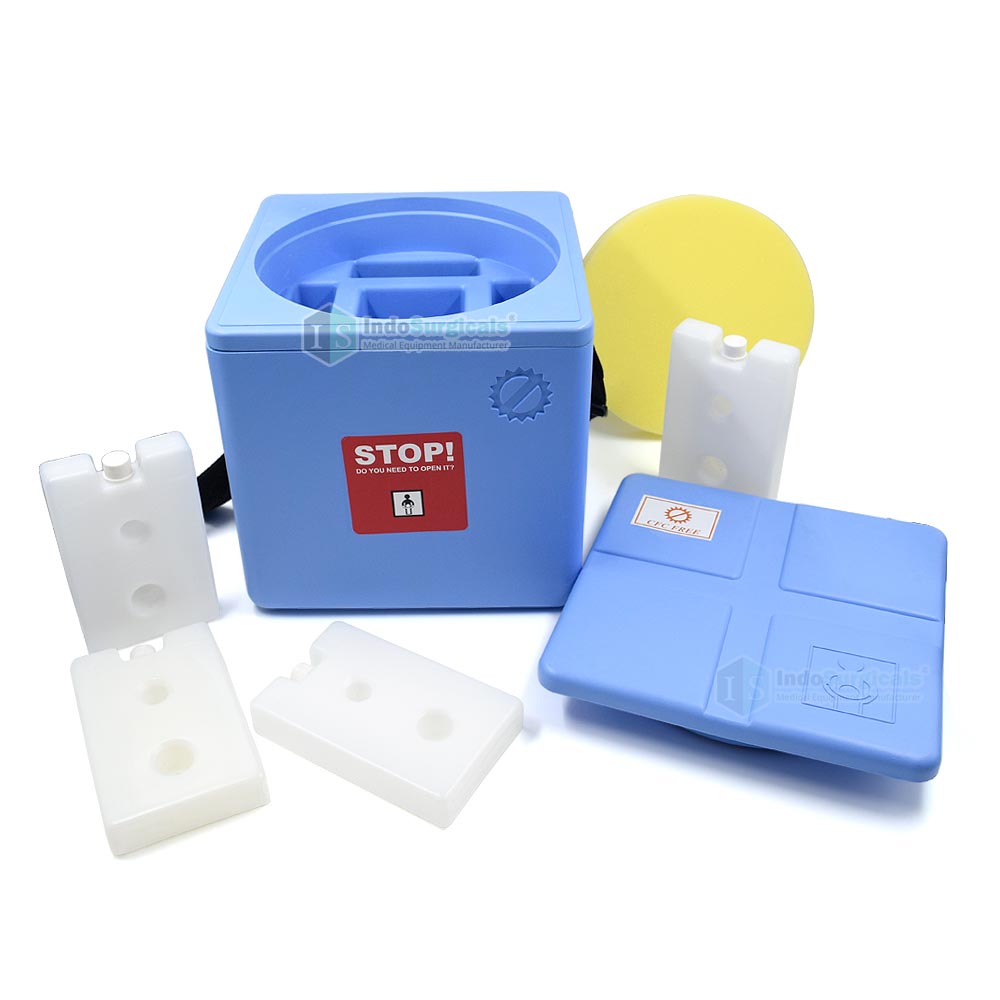
- Vaccine Carrier vs Cold Box vs Ice Pack: the practical difference
- Vaccine carrier boxes: capacity, portability and cold life
- 0.80 L Vaccine Carrier
- 1.35 L Vaccine Carrier
- 2.46 L Vaccine Carrier
- 1.50 L Vaccine Carrier
- When does a vaccine cold box make more sense?
- Short-Range Vaccine Cold Box
- Long-Range Vaccine Cold Box
- Ice packs and water packs: small component, major consequence
- 0.3 L Ice / Water Pack
- 0.4 L Ice / Water Pack
- 0.6 L Ice / Water Pack
- How should hospitals and immunization programmes choose the right equipment?
- Why “cold life” should not be read as a guarantee
- India-specific practical context
- Frequently asked questions
- Explore the related IndoSurgicals cold-chain range
- What is your view?
Vaccine carriers, cold boxes and coolant packs are all part of the vaccine cold chain, but they are not interchangeable. The right choice depends on vaccine volume, journey time, cold life, loaded weight, ambient conditions, coolant-pack configuration and the instructions applicable to the vaccines being transported.
The vaccine cold chain is often discussed as if it were only about refrigerators. In practice, one of the most demanding stages is the movement of vaccines between stores, health facilities and outreach sites. That is where passive cold-chain equipment becomes important: an insulated vaccine carrier or cold box works together with compatible water packs / coolant packs to control the temperature of the vaccine compartment during transport.
Key point: Do not choose a vaccine cold-chain container only by litres. A smaller container can have a longer published cold life than a larger one, and two containers of similar capacity can require very different coolant-pack arrangements.
What counts as passive vaccine cold-chain equipment?
The World Health Organization describes cold boxes and vaccine carriers as passive insulated containers used primarily for vaccine transport and, in some circumstances, temporary storage. They are non-powered systems: temperature control is provided by ice packs, cool water-packs, warm water-packs or another approved thermal storage medium.
For most routine vaccines, the familiar long-term cold-chain condition remains +2°C to +8°C. Some vaccines may have specifically approved controlled-temperature-chain conditions, but those are product- and programme-specific exceptions rather than a reason to ignore normal cold-chain requirements.
Vaccine Carrier vs Cold Box vs Ice Pack: the practical difference
| Equipment | Main purpose | Typical strength | Important limitation |
|---|---|---|---|
| Vaccine carrier | Moving smaller quantities of vaccines to outreach/session sites or between nearby points. | Portable, relatively light and easy for one person to handle. | Lower vaccine storage volume than a cold box. |
| Cold box | Transporting larger vaccine quantities or covering longer passive transport periods. | Higher capacity and generally much longer published cold life. | Can become heavy when fully loaded and may need vehicle/two-person handling. |
| Ice / water pack | Providing thermal mass inside a compatible carrier or cold box. | Reusable and available in standardized sizes. | Must match the container and be prepared correctly; frozen packs are not automatically suitable for every vaccine. |
Vaccine carrier boxes: capacity, portability and cold life
A vaccine carrier is usually the first category considered for outreach activity because it keeps the system compact. The IndoSurgicals range currently includes four carrier configurations from 0.80 L to 2.46 L vaccine storage capacity, including a 1.50 L model with a substantially longer manufacturer-published cold life than the smaller standard models.
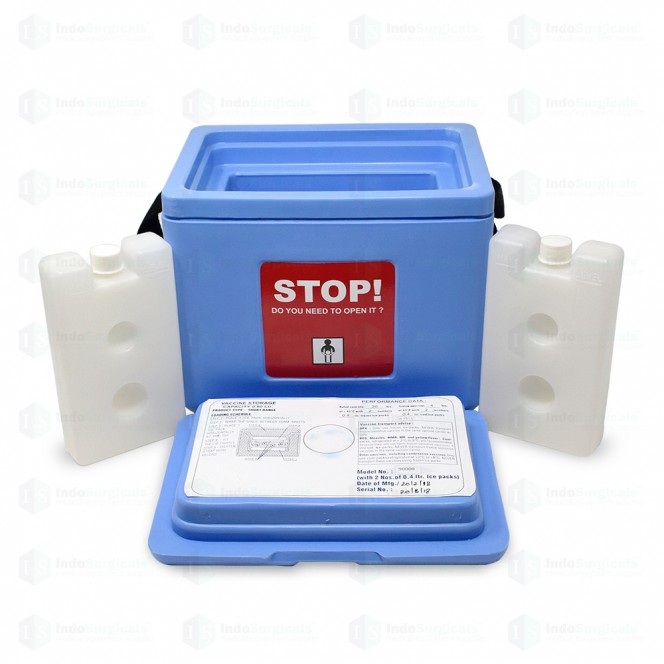
0.80 L Vaccine Carrier
2 × 0.40 L packs; fully loaded weight about 2.18 kg. Manufacturer-published cold life: 3 h 53 min at +43°C.
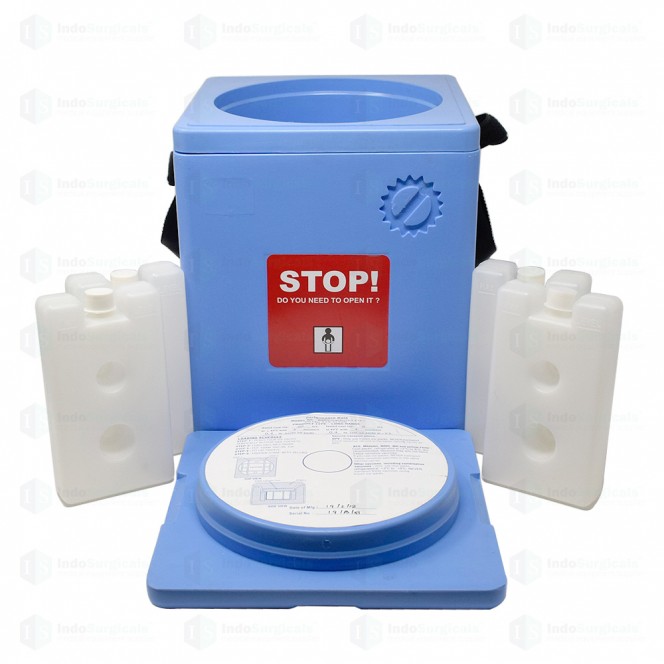
1.35 L Vaccine Carrier
4 × 0.40 L packs; fully loaded weight about 4.36 kg. Manufacturer-published cold life: 9 h 48 min at +43°C.
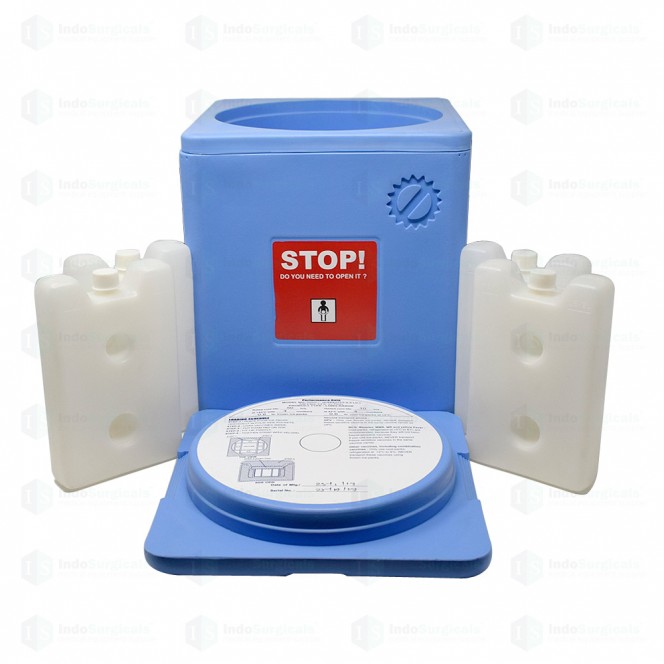
2.46 L Vaccine Carrier
4 × 0.60 L packs; fully loaded weight about 6.36 kg. Manufacturer-published cold life: 9 h 47 min at +43°C.
1.50 L Vaccine Carrier
4 × 0.60 L packs; fully loaded weight about 8 kg. Manufacturer-published cold life: 34 hours at +43°C.
Capacity is not the same as cold life. The 2.46 L model carries more vaccine volume than the 1.50 L model, yet the 1.50 L model has a much longer published cold-life figure. Insulation design, pack quantity, dimensions and thermal geometry matter.
When does a vaccine cold box make more sense?
A cold box becomes more relevant when the vaccine quantity exceeds a practical carrier load, the transport leg is longer, or the programme needs substantially greater passive thermal endurance. It is also important to consider the loaded weight: a cold box may be technically suitable but operationally awkward if staff must repeatedly lift or carry it.
Short-Range Vaccine Cold Box
IndoSurgicals lists two short-range configurations, both with 16 L vaccine storage volume. One uses 32 × 0.4 L water packs and the other 24 × 0.6 L water packs.
- Published cold life at +43°C: about 80 h 19 min and 93 h 33 min.
- Fully loaded weight: about 34.42–35 kg.
- Polyurethane insulation: 65 mm.
Long-Range Vaccine Cold Box
The long-range family currently includes four models with 18 L or 6 L vaccine storage volume and 100 mm polyurethane insulation.
- Published cold life at +43°C: about 126 h 32 min to 147 h 14 min.
- Fully loaded weight: about 25.4–47.86 kg.
- Coolant-pack arrangements vary by model from 0.3 L to 0.6 L packs.
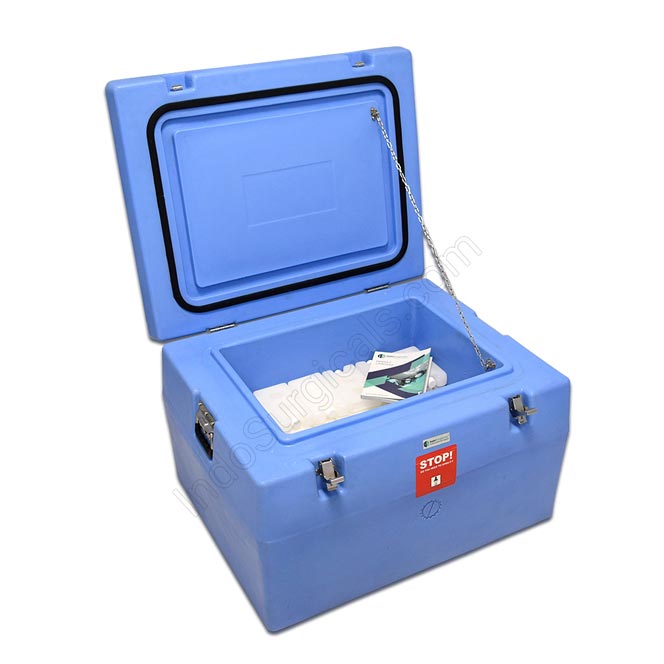
Long-range cold boxes can provide much greater passive holdover, but capacity, route duration and loaded weight should be evaluated together.
Ice packs and water packs: small component, major consequence
WHO's current coolant-pack category recognizes three standard removable pack sizes: 0.3 L, 0.4 L and 0.6 L. The size must be compatible with the cold box or vaccine carrier for which it is intended. A pack is not simply an accessory: its volume, number, preparation temperature and position form part of the thermal system.
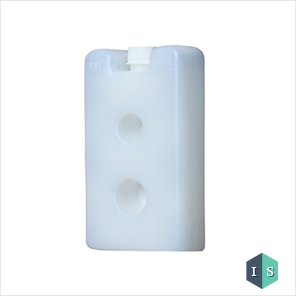
0.3 L Ice / Water Pack
Compact standardized size used in compatible passive vaccine cold-chain systems.
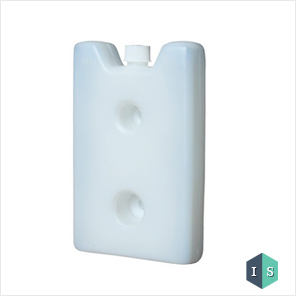
0.4 L Ice / Water Pack
Used by several carrier and cold-box configurations where the thermal design calls for 0.4 L packs.
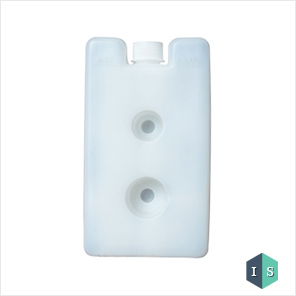
0.6 L Ice / Water Pack
Higher-volume pack used in compatible vaccine carriers and selected short- or long-range cold boxes.
Freeze-sensitive vaccines need special attention. “Colder” is not automatically “safer.” Depending on the vaccine and programme, fully frozen packs may create a freezing risk. Correctly conditioned packs, cool water-packs or freeze-preventive equipment may be required. Always follow the vaccine manufacturer's storage instructions and the applicable immunization programme guidance.
How should hospitals and immunization programmes choose the right equipment?
Why “cold life” should not be read as a guarantee
Published cold life is measured under defined test conditions. Real transport performance can be affected by how the packs were prepared, starting temperature, ambient heat, direct sunlight, how often the lid is opened, container condition, packing technique and unexpected transport delays.
WHO specifically advises end-users to choose equipment with performance long enough for the longest planned transport leg and to allow a safety margin. This is a better procurement approach than selecting a box whose laboratory figure only just matches the planned journey.
India-specific practical context
In India, vaccine movement can range from well-connected urban routes to outreach locations where travel time, summer heat, road conditions and last-mile handling vary significantly. That makes a one-size-fits-all approach difficult.
A small outreach session may benefit from a light vaccine carrier that is easy for a health worker to carry. A district-to-facility replenishment movement may need a much larger cold box. A longer route with uncertain delays may justify a long-range box—but only if the increased loaded weight can be handled safely and the selected coolant-pack method is appropriate for the vaccines.
The best cold-chain equipment is not the biggest box. It is the smallest practical system that safely accommodates the required vaccine volume and provides sufficient thermal performance for the complete transport operation.
Frequently asked questions
What is the difference between a vaccine carrier and a cold box?
A vaccine carrier is generally smaller and easier to carry, making it useful for outreach and smaller vaccine movements. A cold box provides much greater vaccine capacity and generally a longer passive cold life, but it can be considerably heavier when loaded.
What is the normal cold-chain temperature for vaccines?
For most routine vaccines, the standard long-term cold-chain condition is +2°C to +8°C. Some vaccines may have specifically approved controlled-temperature-chain conditions, so the product label and programme guidance must always be checked.
Can any ice pack be used in any vaccine carrier?
No. The correct coolant-pack size and number should match the container design. WHO recognizes common removable sizes of 0.3 L, 0.4 L and 0.6 L, but compatibility still has to be checked for the specific carrier or cold box.
Are frozen ice packs always safe for vaccines?
No. Some vaccines are freeze-sensitive. Depending on the product and programme, conditioned packs, cool water-packs or freeze-preventive containers may be required.
Does a larger vaccine carrier always have a longer cold life?
No. Capacity and cold life are independent specifications. Insulation thickness, geometry, pack configuration and construction all influence thermal performance.
What should be verified before institutional procurement?
Verify usable vaccine storage capacity, cold/cool/warm life, loaded weight, coolant-pack type and quantity, dimensions, construction, temperature-monitoring plan, current technical documentation and any certification or WHO PQS requirement specified by the tender.
Explore the related IndoSurgicals cold-chain range
For readers who want to compare real examples, the following pages cover the complete related range referenced in this topic.
What is your view?
For hospitals, public-health programmes and medical procurement teams, should vaccine cold-chain equipment be standardized around a small number of models, or should selection always be route- and vaccine-specific? How much weight should be given to cold life compared with portability, storage capacity and freeze protection?
Share your evidence, field experience or procurement perspective. The most useful opinions will distinguish between technical performance on paper and what actually works reliably in vaccine transport operations.
Disclosure: IndoSurgicals products are used as real-world examples in this topic, and the product images link to the corresponding IndoSurgicals pages. Product specifications can change; institutional buyers should confirm current model data, test reports, certification scope and regulatory/tender requirements before purchase.
Technical references: World Health Organization IMD-PQS guidance for E004 cold boxes and vaccine carriers, E005 coolant packs, and WHO controlled-temperature-chain guidance. Vaccine-specific manufacturer instructions and national immunization guidance take precedence over general educational content.
How did this opinion land?
Kumar Akhil Yadav
Director at IndoSurgicals Private Limited


Comments
Sign in to share your opinion on this article.
Be the first reader to contribute to this discussion.