
Reflex Hammer Types Explained: Queen Square, Taylor, Tromner, Buck, Babinski and More
Different reflex hammers can look surprisingly different even though they are all used during neurological examination. Queen Square, Taylor or Tomahawk, Tromner, Buck and Babinski hammers vary in head design, weight, balance, handle length and additional examination features.

What to remember
- Queen Square, Taylor, Tromner, Buck and Babinski hammers differ in design and handling.
- No single reflex hammer is best for everyone.
- Technique and familiarity matter more than price or complexity.
Table of contents
- What Is a Reflex Hammer Used For?
- Why Are There So Many Different Reflex Hammer Designs?
- 1. Queen Square Reflex Hammer: The Long-Handled Classic
- Long Handle, Weighted Circular Head
- 2. Taylor or Tomahawk Reflex Hammer: Familiar, Compact and Simple
- The Reflex Hammer Most Students Recognise
- 3. Tromner Reflex Hammer: Two Percussion Surfaces in One Instrument
- One Hammer, Two Contact Surfaces
- 4. Buck Hammer: A Compact Multifunction Neurological Tool
- More Than a Percussion Hammer
- 5. Babinski Hammer: An Adjustable Circular-Head Design
- Another Approach to the Circular Reflex Hammer
- What About the Wartenberg Pinwheel?
- Related to Neurological Examination, but Not a Reflex Hammer
- Queen Square vs Taylor vs Tromner vs Buck vs Babinski
- Why a Complete Neurological Hammer Set Can Be Useful for Teaching
- Which Reflex Hammer Is Best for Medical Students?
- Is an Expensive Reflex Hammer Automatically Better?
- What Should Hospitals and Medical Colleges Consider?
- So Which Reflex Hammer Would I Choose?
- Frequently Asked Questions About Reflex Hammers
- What is a reflex hammer?
- What are the common types of reflex hammers?
- Which reflex hammer is best?
- Is a Queen Square hammer better than a Taylor hammer?
- Why does a Tromner reflex hammer have two heads?
- Is a Wartenberg pinwheel a reflex hammer?
- Which reflex hammer is suitable for medical students?
- Final Thoughts: The Best Reflex Hammer Is the One You Can Use Well
Reflex Hammer Types Explained: Queen Square, Taylor, Tromner, Buck, Babinski and More
A reflex hammer looks like one of the simplest instruments in a doctor's examination kit. Yet put a Queen Square, Taylor, Tromner, Buck and Babinski hammer next to one another and they hardly look like versions of the same tool. Why are there so many designs, and does choosing the right reflex hammer really make a difference?
Quick answer: There is no single reflex hammer that is best for every clinician. A Queen Square provides a long-handle, weighted-head feel; a Taylor is compact and familiar; a Tromner offers two percussion surfaces; a Buck combines percussion with additional examination tools; and a Babinski provides another circular-head configuration. Technique, balance, familiarity and the examination being performed matter more than simply choosing the most elaborate hammer.
What Is a Reflex Hammer Used For?
Most medical students meet the reflex hammer early in clinical training. A tendon is tapped, a movement follows, and something that looked almost too simple to deserve its own instrument suddenly becomes part of neurological examination.
The basic purpose of a reflex hammer is to provide a controlled percussion stimulus during examination of reflex responses. Deep tendon reflexes form one part of a broader neurological assessment and are considered together with other findings rather than interpreted in isolation.
Some reflex hammer designs do more than percussion. Depending on the model, the instrument may include a tapered or pointed handle, different striking surfaces, a brush, an examination point or other features that can support selected parts of a neurological examination.
And that is where the apparently simple question becomes more interesting: if reflex hammers perform broadly similar jobs, why do they look so different?
Why Are There So Many Different Reflex Hammer Designs?
A reflex hammer is a mechanical instrument. How it behaves depends on several very ordinary physical characteristics: the weight of its head, the length and flexibility of its handle, the size of its percussion surface and where the balance of the instrument sits in the hand.
Change any of those things and the hammer can feel surprisingly different.
A long handle and weighted head can create momentum with a relatively relaxed swing. A compact triangular hammer may feel more direct. A dual-head instrument gives the examiner two different contact surfaces. A multifunction hammer may trade some simplicity for the convenience of additional examination tools.
This is why personal preference matters more with reflex hammers than a first-year medical student might expect. A clinician who has used the same pattern for years may be extremely consistent with it, while another examiner may genuinely prefer a completely different design.
1. Queen Square Reflex Hammer: The Long-Handled Classic
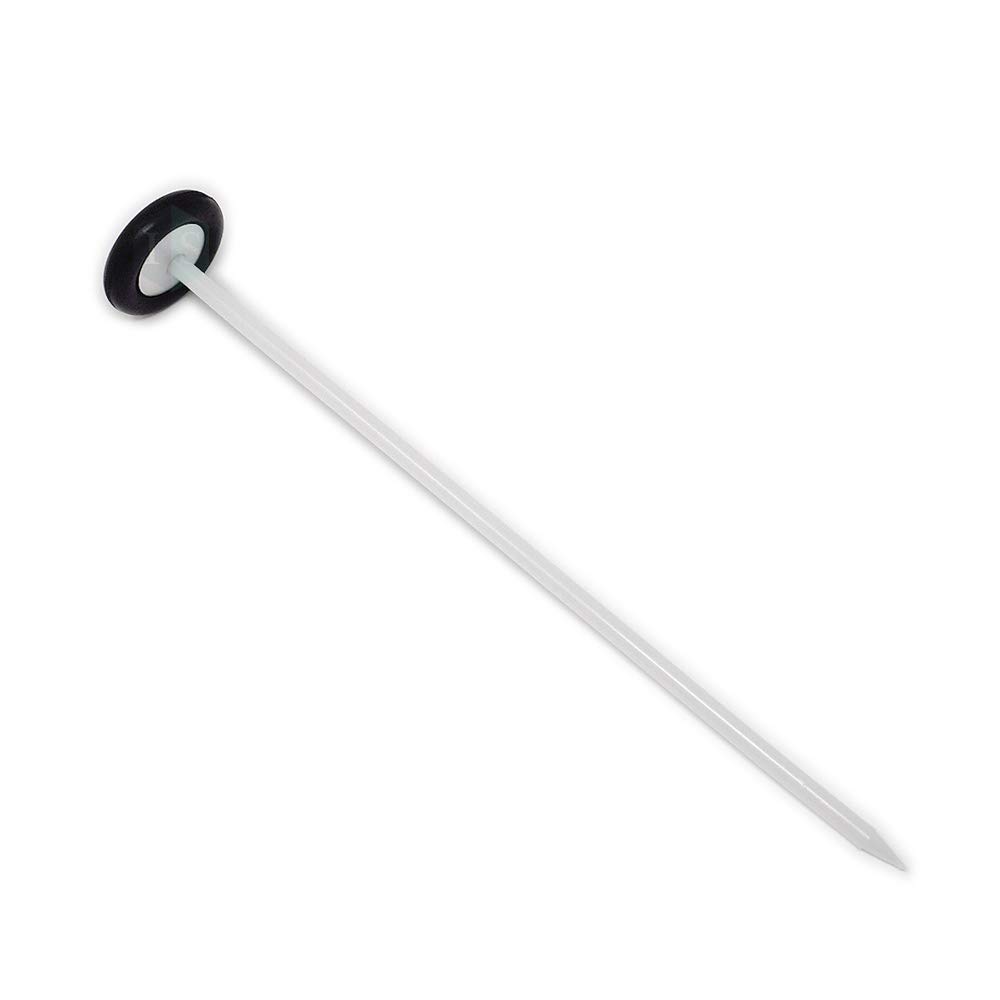
Queen Square Reflex Hammer. Click the photograph to view the product on IndoSurgicals.
Long Handle, Weighted Circular Head
The Queen Square is probably one of the most recognisable specialist neurological reflex hammers. Instead of the triangular head seen on a Taylor hammer, it uses a circular weighted head with a percussion ring and a relatively long handle.
The example shown here is the IndoSurgicals Queen Square model. Its product specification lists an approximately 50 mm chrome-plated brass disc, soft rubber ring and flexible nylon handle.
The combination of head weight and handle length gives the Queen Square a distinctive swinging action. Once familiar with the technique, some examiners appreciate how the hammer's momentum can provide a controlled percussion stimulus without an exaggerated wrist movement.
View Queen Square Reflex Hammer →Another practical detail is the handle itself. A tapered or pointed end on selected Queen Square designs may support examination of plantar or abdominal responses when used with appropriate clinical technique.
That makes the Queen Square more than simply a hammer with a larger head. Its proportions are part of the way the instrument is intended to be handled.
2. Taylor or Tomahawk Reflex Hammer: Familiar, Compact and Simple
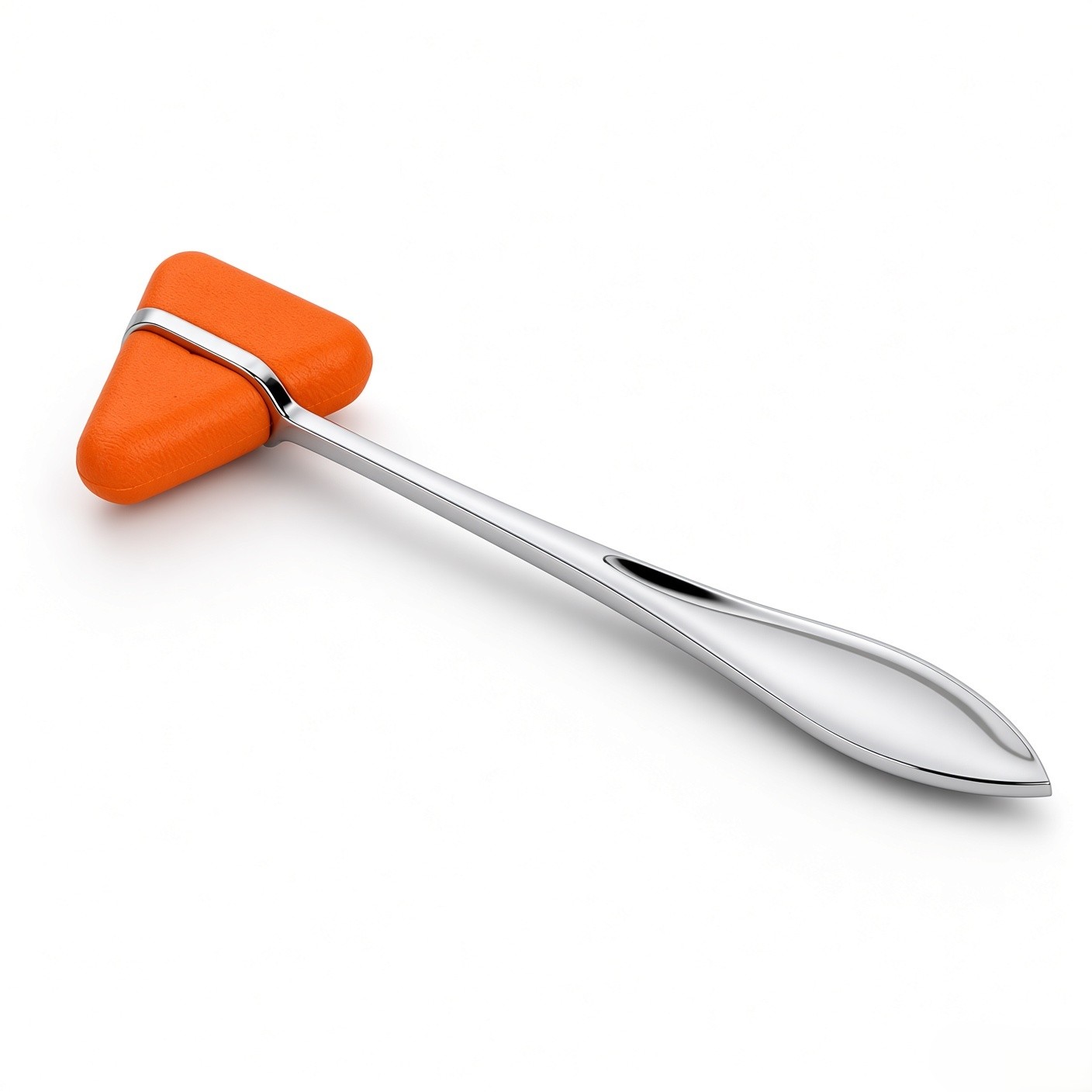
Taylor or Tomahawk Neurological Reflex Hammer by IndoSurgicals.
The Reflex Hammer Most Students Recognise
Ask someone to sketch a reflex hammer from memory and there is a good chance they will draw something resembling a Taylor hammer.
The triangular percussion head gives the instrument its familiar tomahawk appearance. It is easy to carry, straightforward to understand and commonly encountered in medical training.
The IndoSurgicals Taylor/Tomahawk model pictured here uses a silicone triangular head with a weighted anodized handle. Its current product specification also lists the model as latex-free.
View Taylor / Tomahawk Hammer →The Taylor does not produce exactly the same handling experience as a long Queen Square hammer, but that is not necessarily a disadvantage. Compact dimensions and familiar handling can be useful, especially for someone carrying an examination kit throughout the day.
For a student learning tendon reflex examination for the first time, simplicity is often more valuable than owning the most complicated instrument available.
3. Tromner Reflex Hammer: Two Percussion Surfaces in One Instrument
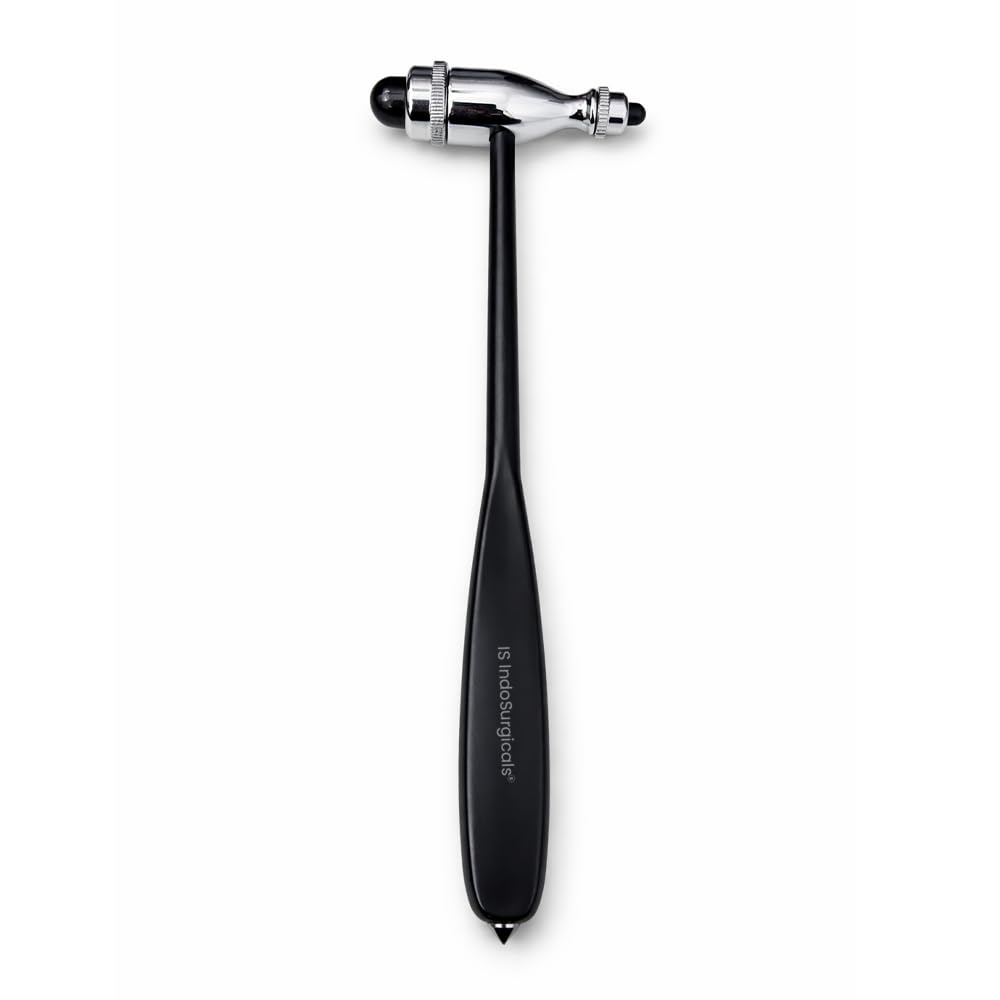
IndoSurgicals Tromner Reflex Hammer with large and small percussion surfaces.
One Hammer, Two Contact Surfaces
The defining feature of a Tromner reflex hammer is its dual-head configuration. The examiner has a larger percussion surface at one end and a smaller one at the other.
That gives the design a useful degree of flexibility. The examiner can choose a percussion surface according to the tendon location, anatomical site and preferred examination technique.
The IndoSurgicals Tromner shown here uses a lightweight fibre handle and also has a pointed handle end for selected cutaneous or sensory-response testing.
View Tromner Reflex Hammer →There are also different interpretations of the Tromner pattern itself. A lightweight fibre handle and a heavier metal handle will not feel identical even when the overall hammer-head concept is similar.
This illustrates an important point when comparing reflex hammers: the pattern name alone does not tell you everything about balance and handling.
4. Buck Hammer: A Compact Multifunction Neurological Tool
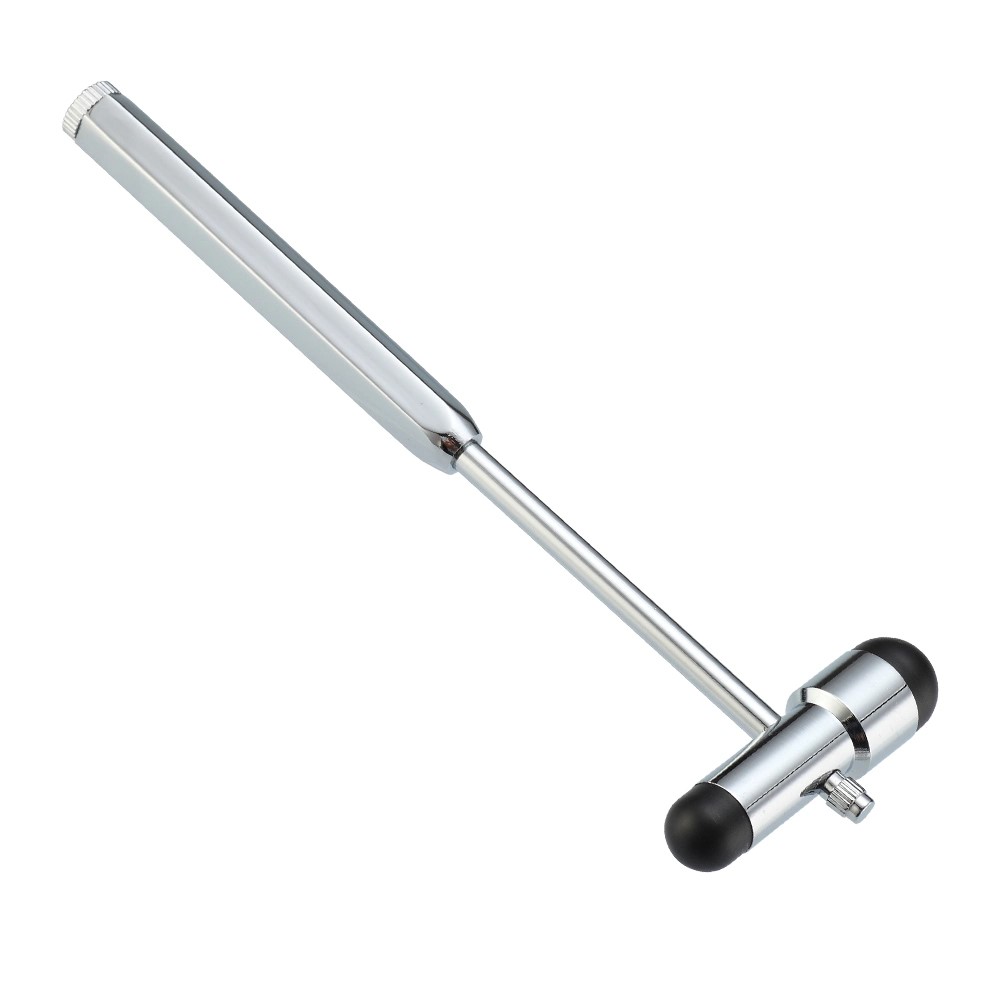
Buck Hammer by IndoSurgicals with double-ended percussion head.
More Than a Percussion Hammer
The Buck hammer takes a different approach. Rather than focusing only on the shape of the percussion head, it incorporates additional examination tools into a compact instrument.
The IndoSurgicals model has a two-sided synthetic rubber head together with an integrated brush and examination point. Its listed overall length is approximately 7½ inches.
This multifunction layout can be convenient for someone who prefers carrying one compact instrument with several examination features rather than separate tools.
View Buck Hammer →Convenience, however, is not the same thing as universal superiority. Some clinicians prefer a specialised percussion hammer with a particular balance; others value the Buck's all-in-one approach.
5. Babinski Hammer: An Adjustable Circular-Head Design
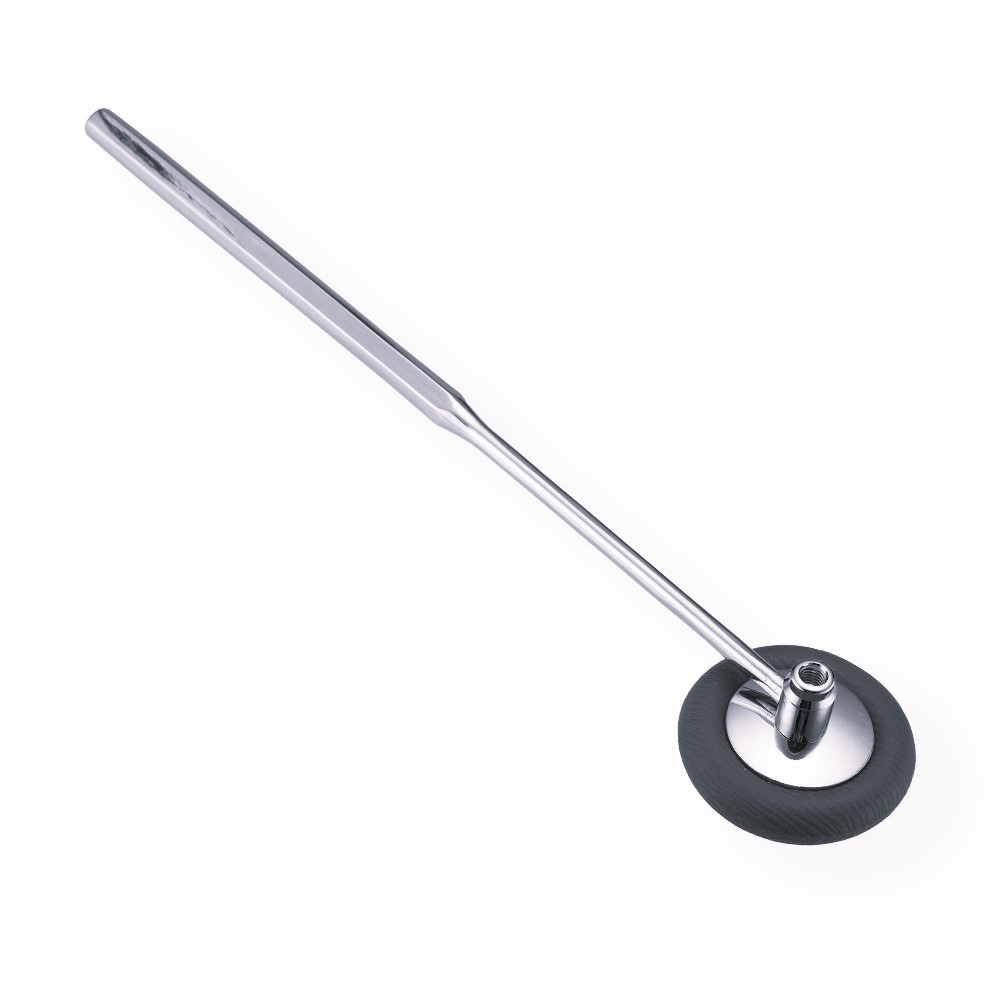
IndoSurgicals Babinski Hammer with circular percussion head.
Another Approach to the Circular Reflex Hammer
The Babinski hammer again changes the geometry. Instead of a triangular Taylor head or the dual-head arrangement of a Tromner, this pattern uses a circular percussion head mounted on a relatively long shaft.
The current IndoSurgicals Babinski model lists a 9-inch shaft and an adjustable circular head that can be positioned parallel or perpendicular to the handle. The pointed lower end provides an additional feature for selected sensory examination.
The manufacturer's specification for this particular model states that its rubber head contains latex, which is worth checking when latex-related requirements are relevant to the clinical environment.
View Babinski Hammer →What About the Wartenberg Pinwheel?
The Wartenberg pinwheel often appears beside reflex hammers in neurological instrument collections, but it is important not to describe it simply as another tendon-reflex hammer.
It is primarily a sensory examination instrument. Its small rotating wheel has multiple points and is used by appropriately trained examiners during selected sensory-response assessments.

Wartenberg Pinwheel by IndoSurgicals.
Related to Neurological Examination, but Not a Reflex Hammer
The IndoSurgicals Wartenberg Pinwheel is made from stainless steel and its listed specification includes 22 metal points around the rotating wheel.
Its presence in neurological examination sets makes sense: a complete neurological assessment can involve much more than simply eliciting tendon reflexes.
View Wartenberg Pinwheel →Queen Square vs Taylor vs Tromner vs Buck vs Babinski
There is no meaningful way to rank these hammers from “best” to “worst” without considering who is using them and why. A more useful comparison is to look at the characteristic that distinguishes each design.
| Reflex Hammer | Characteristic Design | What Stands Out | Who May Appreciate It |
|---|---|---|---|
| Queen Square | Long flexible handle with weighted circular head | Momentum and swinging action | Clinicians who prefer a traditional neurological hammer feel |
| Taylor / Tomahawk | Compact triangular percussion head | Simple, familiar and portable | Students and clinicians who prefer a compact conventional design |
| Tromner | Large and small percussion surfaces | Choice of two contact areas | Examiners who value dual-head versatility |
| Buck | Two-sided head with additional examination tools | Multifunction design | Users who value compact all-in-one instruments |
| Babinski | Adjustable circular percussion head | Long shaft and repositionable head | Clinicians who prefer the Babinski pattern and its handling |
A Taylor/Tomahawk or another compact reflex hammer is an obvious place to start.
The Queen Square pattern is worth trying because its handling is quite different from a short Taylor hammer.
The Tromner's large and small heads provide two choices within the same instrument.
A Buck hammer integrates additional neurological examination tools into the design.
Why a Complete Neurological Hammer Set Can Be Useful for Teaching
Individual clinicians generally do not need to carry five different reflex hammer patterns simply because five exist. Teaching is different.
When several designs are placed side by side, students can immediately see that the difference is not cosmetic. Head shape, length, weight distribution, percussion surface and additional testing features vary substantially between instruments.
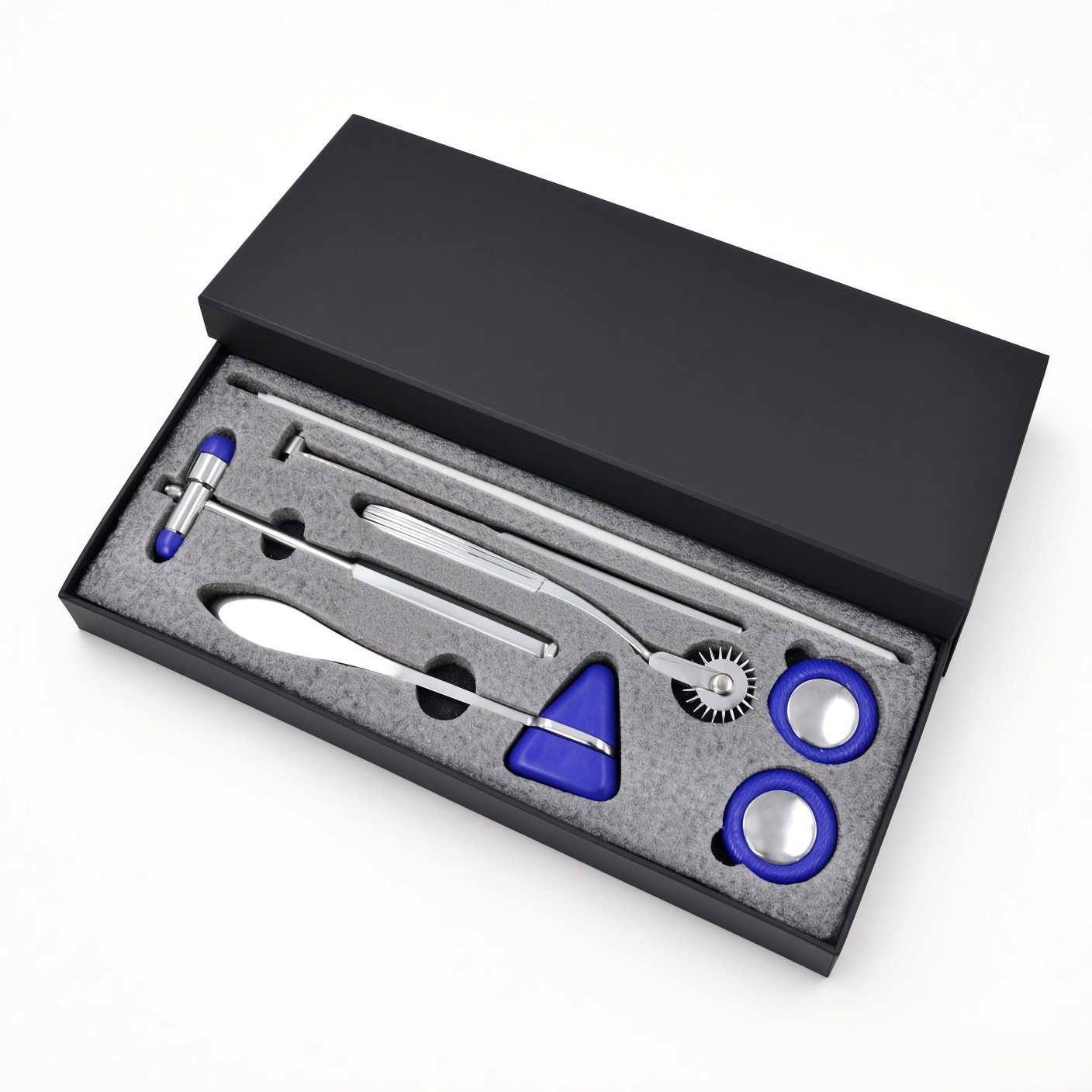
A neurological examination set makes it easier to compare several established instrument patterns. Click the image to view the IndoSurgicals set.
The current IndoSurgicals Neurological Reflex Medical Hammer Set brings together a Wartenberg pinwheel, Babinski percussion hammer, Taylor/Tomahawk hammer, Buck hammer and Queen Square hammer.
For a skills laboratory or teaching environment, that variety can be more valuable than simply buying several identical hammers. It lets learners experience the physical differences rather than only reading about them.
Which Reflex Hammer Is Best for Medical Students?
Medical students are often tempted to turn every instrument purchase into a search for the “best professional model”. With reflex hammers, that may be unnecessary.
A sensible first reflex hammer should be easy to use, durable enough for regular carrying, comfortable in the hand and similar to the type being demonstrated during clinical teaching.
For many students, that makes a Taylor/Tomahawk a perfectly reasonable starting point. It is compact, recognisable and easy to keep in an examination kit.
A Queen Square or Tromner becomes interesting when a student wants to experience a different balance or expects to spend more time learning neurological examination. There is also nothing wrong with trying several designs before deciding which feels most natural.
A useful rule: do not buy a particular reflex hammer simply because it looks more specialised. A simple instrument that you understand and use consistently can be more useful than an elaborate design you have not learned to handle properly.
Is an Expensive Reflex Hammer Automatically Better?
Not necessarily.
Reflex hammers are a good example of why price and clinical usefulness are not always the same thing. The instrument has a relatively simple mechanical purpose. What matters is the quality of the percussion surface, appropriate weight and balance, durability and whether the design suits the examiner's technique.
A beautifully made hammer does not compensate for poor patient positioning, incorrect technique or inappropriate interpretation of examination findings.
Equally, an experienced clinician can be remarkably consistent with a comparatively simple hammer they have used for years.
What Should Hospitals and Medical Colleges Consider?
Buying a reflex hammer for yourself and purchasing instruments for an institution are slightly different decisions.
Hospitals, teaching departments and medical colleges may want to consider:
- the type of reflex hammer used in their teaching programme;
- durability during repeated clinical or training use;
- the weight and balance of the instrument;
- ease of cleaning under the institution's approved procedure;
- whether latex-related requirements apply;
- whether sensory-testing accessories are required;
- availability of individual replacement instruments;
- and whether students should be exposed to several different hammer patterns.
IndoSurgicals currently lists 12 products in its Medical Reflex Hammers range , including individual hammers, sensory examination instruments and complete sets.
So Which Reflex Hammer Would I Choose?
If I wanted the simplest answer, I would separate the choice by use rather than trying to crown one universal winner.
For a first medical-school examination kit, I would be perfectly comfortable starting with a Taylor/Tomahawk. If I expected to perform neurological examinations regularly, I would want to try a Queen Square and Tromner before deciding which handling style I preferred.
If compact multifunctionality mattered to me, I would look closely at a Buck. If I already preferred the Babinski pattern, there would be little reason to abandon it simply because another design was more fashionable.
That answer may be less exciting than declaring one model “the best”, but it is probably closer to how clinical instruments actually work in practice.
Familiarity matters. Technique matters. The examination matters.
The hammer matters too—but it is only one part of the process.
Frequently Asked Questions About Reflex Hammers
What is a reflex hammer?
A reflex hammer is a medical examination instrument used to provide controlled percussion during assessment of reflex responses, including deep tendon reflexes.
What are the common types of reflex hammers?
Common designs include Queen Square, Taylor or Tomahawk, Tromner, Buck and Babinski reflex hammers. Different patterns vary in head design, handle length, weight, percussion surface and additional examination features.
Which reflex hammer is best?
There is no single best design for every examiner. The choice depends on balance, handling preference, examination technique, portability and familiarity with the particular hammer.
Is a Queen Square hammer better than a Taylor hammer?
They provide different handling characteristics rather than a simple good-versus-bad comparison. A Queen Square has a longer handle and weighted circular head, while a Taylor is compact and uses a triangular percussion head.
Why does a Tromner reflex hammer have two heads?
A Tromner uses large and small percussion surfaces, giving the examiner a choice of contact area according to the anatomical location and examination technique.
Is a Wartenberg pinwheel a reflex hammer?
No. A Wartenberg pinwheel is principally a sensory examination instrument. It is frequently grouped with neurological reflex instruments because both may form part of a broader neurological examination kit.
Which reflex hammer is suitable for medical students?
A compact Taylor/Tomahawk is a sensible first option for many students, although students particularly interested in neurological examination may also wish to try Queen Square or Tromner patterns.
Final Thoughts: The Best Reflex Hammer Is the One You Can Use Well
A reflex hammer is a small instrument, but its many designs tell an interesting story about clinical preference.
Queen Square, Taylor, Tromner, Buck and Babinski hammers solve broadly similar examination requirements with noticeably different combinations of weight, length, percussion surface and additional features.
That is why the question “Which reflex hammer is best?” does not have one universal answer. A better question is: which hammer gives a trained examiner the balance, control and handling they prefer for the examination being performed?
Readers who want to compare the physical designs can explore the complete IndoSurgicals Medical Reflex Hammers range .
Sometimes the simplest medical instruments are the ones that make personal technique most obvious.
How did this opinion land?
Kumar Akhil Yadav
Director at IndoSurgicals Private Limited


Comments
Sign in to share your opinion on this article.
Be the first reader to contribute to this discussion.