Gopal Haldar's opinion on Defence spending vs public welfare
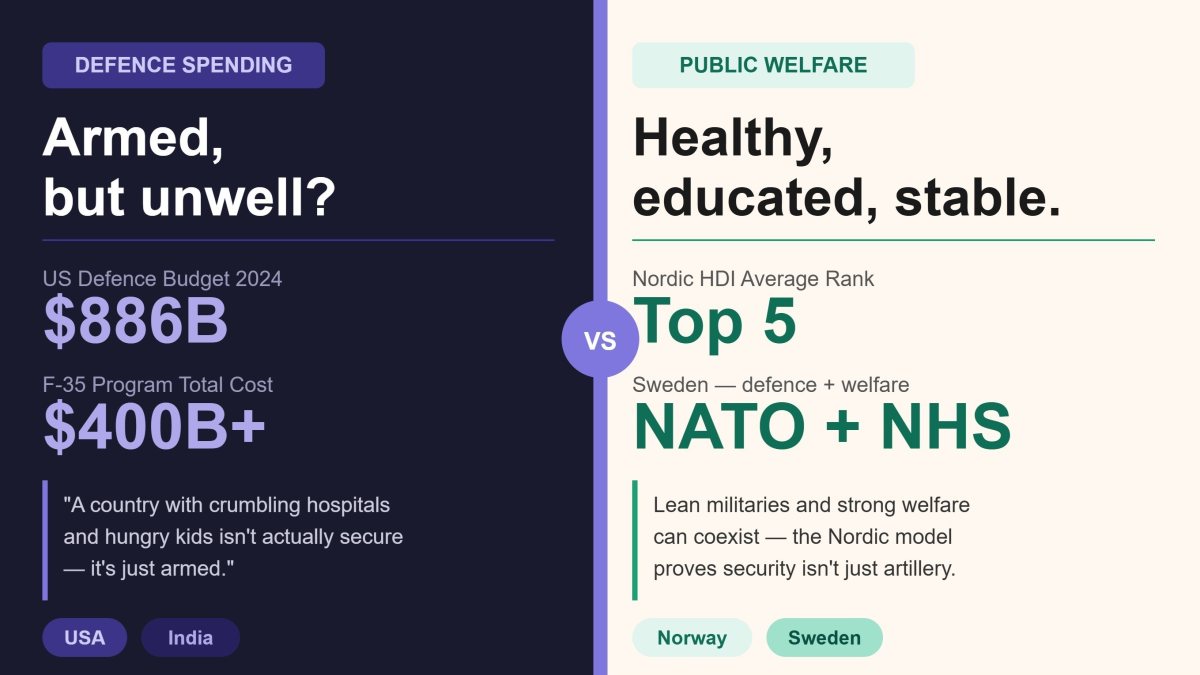
The framing of "defence vs. welfare" is itself a bit of a trap. A country with crumbling hospitals and hungry kids isn't actually secure — it's just armed. Real national strength comes from the population being healthy, educated, and economically stable. That said, dismissing defence as wasteful ignores genuine geopolitical realities. The honest answer is: it's about proportion and priority, not either/or.That said, when defence budgets balloon beyond credible threat levels — often driven by lobbying, legacy contracts, or political optics — the opportunity cost falls squarely on public welfare. And that's where I think the balance tips wrong.
2. Nordic Countries — Proof the Balance Can Work: Sweden, Norway, and Denmark maintain credible, modern militaries while investing heavily in education, healthcare, and social safety nets. They're not naive about threats — Sweden literally rejoined NATO in 2024 — but they've never bought into the idea that social spending is a luxury. The result? High HDI scores, strong social cohesion, and militaries that are lean but genuinely capable.
3. India — The Uncomfortable Middle Ground: India is a fascinating case. It's the world's largest arms importer, running a significant defence budget, while hundreds of millions still lack reliable sanitation, clean water, and quality public healthcare. The argument is regional security — Pakistan, China, real pressures. But when defence procurement involves sweetheart deals and import dependencies, it starts looking less like strategic necessity and more like elite priority-setting dressed in security language.
Defence spending has a legitimate role. But the moment it becomes a default budget sink — immune to scrutiny that every health or education rupee faces — it stops being about security and starts being about power, contracts, and optics. Public welfare isn't the soft option. It's actually the long game.
Examples Worth Thinking About
1. The United States — The Classic Overcorrection: The US spends more on defence than the next 10 countries combined, yet ranks poorly among developed nations on healthcare access, infant mortality, and poverty rates. The F-35 program alone has cost over $400 billion in development. Meanwhile, millions remain uninsured. This isn't a security trade-off — it's institutional momentum dressed up as patriotism.2. Nordic Countries — Proof the Balance Can Work: Sweden, Norway, and Denmark maintain credible, modern militaries while investing heavily in education, healthcare, and social safety nets. They're not naive about threats — Sweden literally rejoined NATO in 2024 — but they've never bought into the idea that social spending is a luxury. The result? High HDI scores, strong social cohesion, and militaries that are lean but genuinely capable.
3. India — The Uncomfortable Middle Ground: India is a fascinating case. It's the world's largest arms importer, running a significant defence budget, while hundreds of millions still lack reliable sanitation, clean water, and quality public healthcare. The argument is regional security — Pakistan, China, real pressures. But when defence procurement involves sweetheart deals and import dependencies, it starts looking less like strategic necessity and more like elite priority-setting dressed in security language.
Defence spending has a legitimate role. But the moment it becomes a default budget sink — immune to scrutiny that every health or education rupee faces — it stops being about security and starts being about power, contracts, and optics. Public welfare isn't the soft option. It's actually the long game.
Author Profile
Comments
Login to Comment